Some numbers just carry weight. Pi. The golden ratio. And in the yoga tradition, 108.
If you've spent any time around yoga studios, you've probably heard of 108 sun salutations, the practice of moving through the sequence 108 times, often at a solstice or equinox. It sounds like a lot. It is a lot. And that's not incidental - that's the whole point.
Why 108?
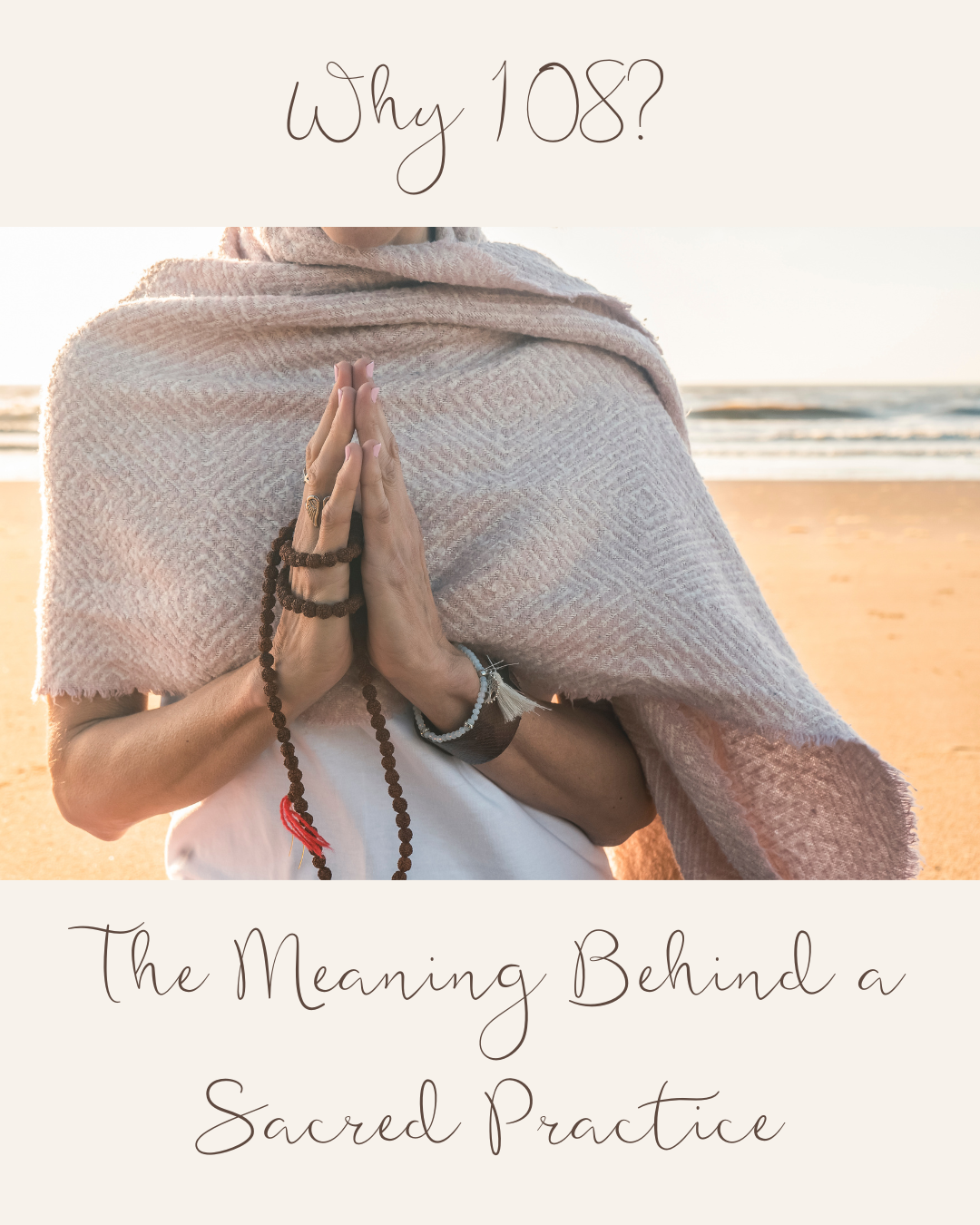
The number 108 appears through cultures and traditions with striking consistency. In Hindu cosmology, there are 108 Upanishads (the ancient philosophical texts of India). There are 108 sacred sites in India, 108 names of the divine in several traditions, and 108 beads on a mala, the prayer necklace used in meditation (one bead for each repetition of a mantra or breath). Buddhist traditions also honor 108, and in some schools, a bell is rung 108 times on New Year's Eve to clear 108 earthly temptations.
The number has mathematical resonance, too. The diameter of the sun is approximately 108 times the diameter of the Earth. The average distance from Earth to the Sun is roughly 108 times the Sun's diameter. The distance from Earth to the moon is approximately 108 times the moon's diameter. This number has always carried meaning as a bridge between the human and the cosmic.
In yoga specifically, 108 represents the wholeness of the universe: 1 (the singular, the self), 0 (emptiness, unlimited potential), and 8 (infinity). Together: the self, moving through emptiness, toward what has no end.
Why the Solstice?
108 sun salutations are most commonly practiced at the summer and winter solstices, and at the spring and fall equinoxes, the four points in the year when the Earth is in a specific relationship to the sun.
There's something honest about marking time this way. The solstice is real. The shift is real. And the practice of moving 108 times—reaching toward the sun, returning to earth, again and again—is a physical acknowledgment of that cycle.
Seasonal transitions have long been used in contemplative traditions as periods of reflection and renewal. Behavioral science backs this up. A study published in Management Science analyzing millions of data points, including gym visits, online commitment contracts, and goal-setting searches, found that people are significantly more likely to pursue aspirational behaviors at "temporal landmarks". Simply put, we rely on dates that feel like a fresh start—New Year's Day, birthdays, the first day of a season. Researchers found these moments create a psychological separation from past setbacks, making people more motivated to begin again. The solstice is one of the most ancient temporal landmarks we have.
Doing 108 sun salutations on or near the solstice is one way to meet that moment with intention. Not as a performance. Not as a feat. But as a way of saying: I am here. I am marking this. I am moving.
The Personal Challenge: Mind as Much as Body
Here is what nobody tells you before you try 108 sun salutations: the physical challenge is real, but it's not the hardest part.
Around round 30, your arms start to feel the work. Around round 60, something mental happens. The mind starts to negotiate. Maybe I'll stop at 72. That's a good number. Around round 80, something else happens. You're tired. Your pace has slowed. And you're still going, not because it's easy, but because you chose to be here, and you're still choosing it.
This is where 108 becomes a practice within something much larger than yoga.
The Mental Benefits of Sustained Challenge
Research on endurance practices consistently shows that sustained effort in the face of discomfort builds psychological resilience, defined as the ability to withstand pressure over time using personal qualities. A study published in the International Journal of Environmental Research and Public Health followed participants through a 25-day extreme endurance challenge and found that when stressors accumulated into what the researchers called a "cluster effect," those who fared best adopted a challenge mindset. Those who actively reappraised pressure as a difficult but meaningful learning experience didn't suffer less. But they related to the suffering differently.
108 sun salutations ask you to stay. To breathe. To keep going not by force, but by choice. And in that choosing, round after round, something shifts. The pressure doesn't disappear, but your relationship to it does.
There is also the element of moving meditation. By round 40, if you've stayed with your breath, the mind has usually quieted. The sequence becomes rhythmic. The thinking mind steps back. What remains is breath, movement, and presence. Some practitioners describe the later rounds of 108 as the most meditative of their practice. Not despite the difficulty, but because of it.
The Four Pebbles Mountain
At Four Pebbles, we talk about solidity, or the Mountain quality. Solidity is not rigidity. It's the deep stability that comes from showing up again and again, from being present through discomfort, from knowing that you can hold yourself even when it's hard. 108 sun salutations is one of the most direct paths to that quality.
You don't have to be advanced. You don't have to complete all 108 on your first attempt. Many practitioners take modifications, slow down, or rest in child's pose before continuing. The practice honors effort and breath, not achievement. A teacher is there to help you find your pace, not to push you beyond it.
You Don't Have to Be Ready. You Just Have to Begin.
The beautiful thing about 108 is that you never feel fully ready. And that's okay. You begin anyway. Round by round, breath by breath. And somewhere in the middle, probably when you least expect it, you realize you've found something solid in yourself.
We'd love for you to find it with us.
Sign up for our upcoming 108 Sun Salutations Challenge on June 21, 2026.